
Modern organizations rely on SIEM and XDR platforms to improve visibility across their environments and strengthen threat detection and response capabilities. These platforms help security teams collect and analyze security telemetry from across their entire environments, including endpoints, servers, cloud workloads, containers, and network devices. By centralizing this data, security analysts can investigate suspicious activity more efficiently, detect threats faster, maintain visibility into compliance, and respond to incidents from a single platform.
However, running a self-managed SIEM or XDR platform introduces operational complexity. As environments grow, organizations must continuously manage storage capacity, indexing performance, scaling, upgrades, high availability, backup strategies, and overall platform maintenance. Maintaining the infrastructure that supports security operations can become a major responsibility, often consuming time and resources that security teams would rather dedicate to threat hunting, detection engineering, and incident response.
Wazuh Cloud is designed to optimize security operations by delivering the capabilities of the Wazuh Platform in a fully managed environment. Instead of maintaining backend infrastructure and managing platform scalability, organizations can focus on monitoring their environments, investigating alerts, and improving security operations while Wazuh handles platform management, maintenance, and availability.
The operational challenges of self-managed security platforms
Running a SIEM or XDR platform at scale is not a one-time deployment effort. It requires continuous operational management as environments evolve and telemetry volumes increase.
Security teams managing their own deployments are typically responsible for:
- Monitoring cluster health and platform performance
- Troubleshooting ingestion bottlenecks and infrastructure issues
- Managing storage retention and index lifecycle policies
- Coordinating upgrades across platform components
- Scaling infrastructure to support growing endpoint and log volumes
- Maintaining high availability and disaster recovery readiness
These operational tasks often grow alongside the organization itself. What begins as a manageable deployment can quickly become resource-intensive as environments expand. In many cases, organizations do not lack visibility due to insufficient security tooling; they lack the operational capacity to maintain and scale those tools effectively.
What is Wazuh Cloud?
Wazuh Cloud is a fully managed hosted deployment of the Wazuh platform designed to simplify security operations by removing the infrastructure management burden associated with self-hosted SIEM and XDR deployments.
The platform handles:
- Infrastructure provisioning
- Availability and maintenance
- Updates, patching, and scaling
This allows security teams to adopt Wazuh without dedicating internal resources to maintaining SIEM infrastructure. Organizations can onboard endpoints, collect telemetry, monitor security events, and investigate threats, while the platform infrastructure is managed on their behalf.
Benefits of Wazuh Cloud
Faster deployment and time to value
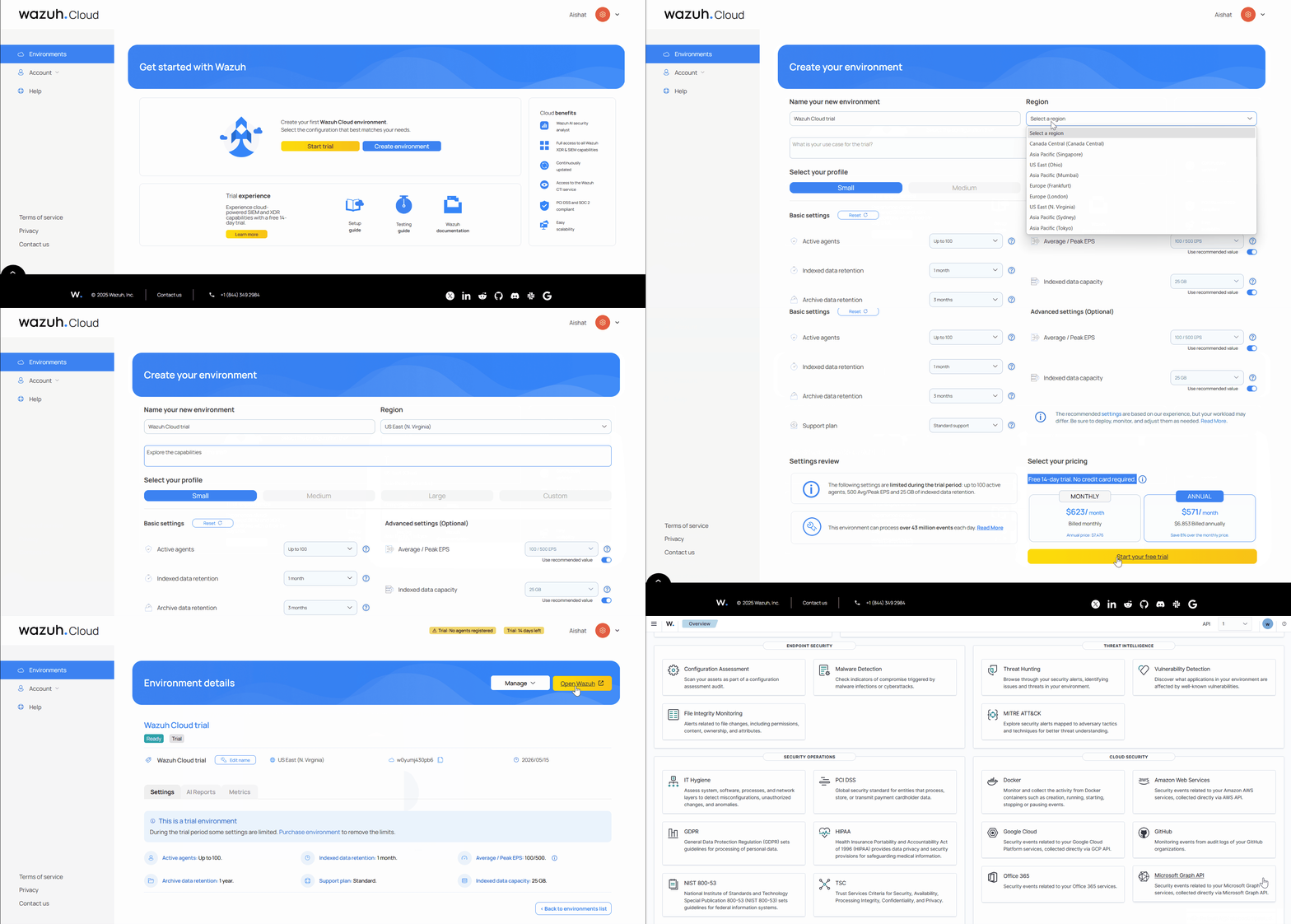
Deploying and scaling self-managed SIEM infrastructure can be time-consuming, particularly when planning cluster architecture, storage requirements, and high availability. With Wazuh Cloud, organizations can deploy environments, collect security data, and protect endpoints more efficiently.
Built-in scalability
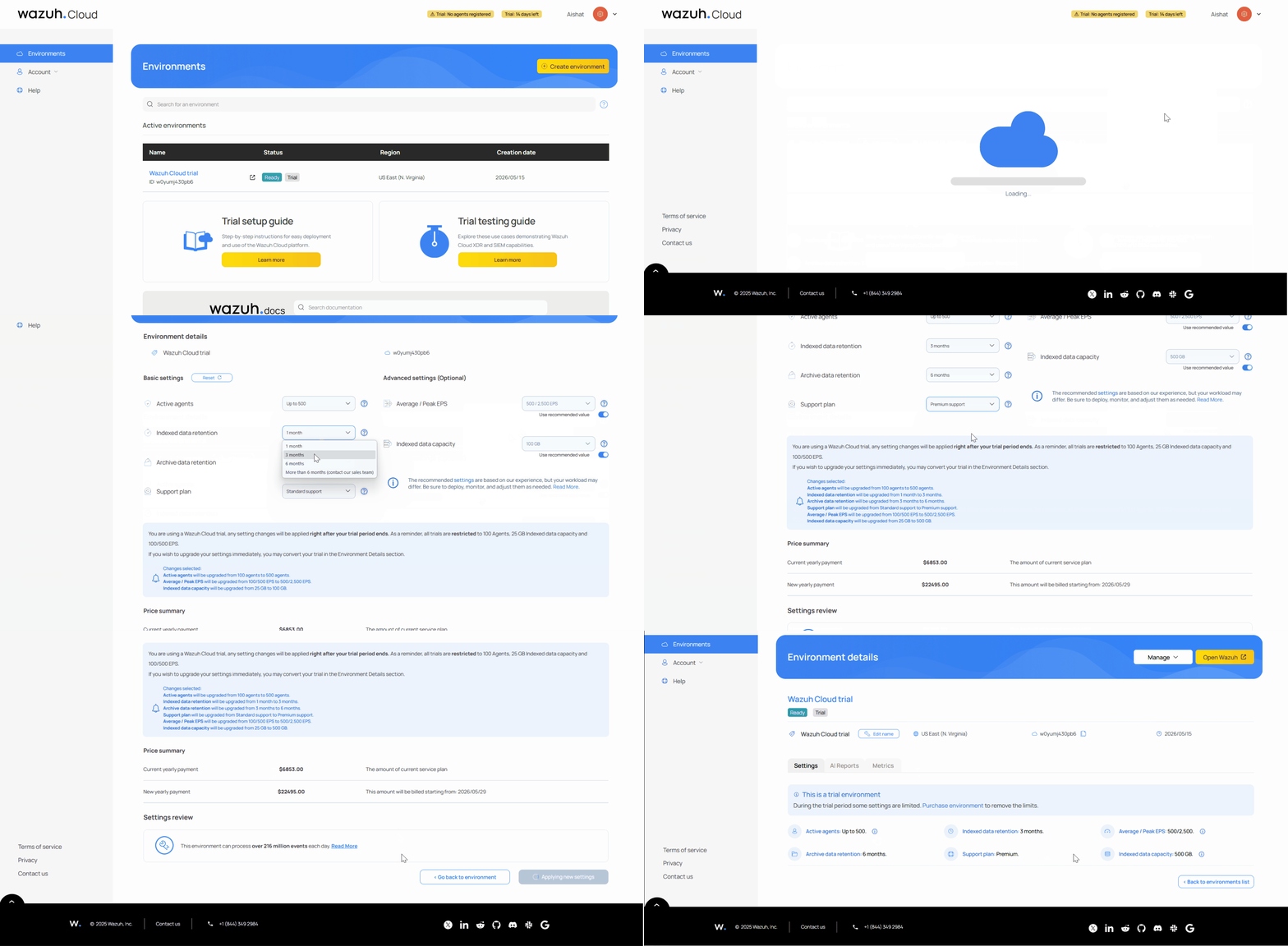
As environments grow, telemetry volumes and operational demands increase with them. Wazuh Cloud is designed to scale alongside organizational growth without requiring manual cluster redesigns or emergency infrastructure expansion.
Organizations can expand monitoring coverage across endpoints, servers, cloud workloads, and distributed environments without continuously reengineering the platform.
Continuous updates and platform maintenance
Maintaining a self-managed deployment requires organizations to coordinate upgrades, validate component compatibility, and minimize downtime during maintenance windows.
Wazuh Cloud simplifies this process by handling updates and maintenance as part of the managed service. Organizations gain faster access to new features, improvements, and detection capabilities while reducing operational risk.
Access to Wazuh professional support
Wazuh Cloud subscriptions include access to Wazuh professional support, providing organizations with direct access to technical expertise and faster issue resolution through guaranteed service-level agreements (SLAs). Beyond infrastructure management, Wazuh experts help organizations optimize their Wazuh deployment for SIEM and XDR operations by assisting with:
- Detection rule development and tuning
- Decoder development and customization
- Advanced integrations
- Noise reduction and use case implementation
This helps organizations improve detection effectiveness, reduce unnecessary alert volume, and adapt Wazuh more efficiently to their specific environments and security requirements.
Focus on security, not infrastructure
Security teams are most effective when they can focus on detection, investigation, and response. By reducing infrastructure management responsibilities, Wazuh Cloud helps organizations dedicate more time to the following:
- Proactive threat hunting and alert investigation
- Advanced detection engineering and incident response
- Compliance monitoring and posture optimization
This operational shift helps teams improve efficiency while reducing administrative workload.
AI-driven reports
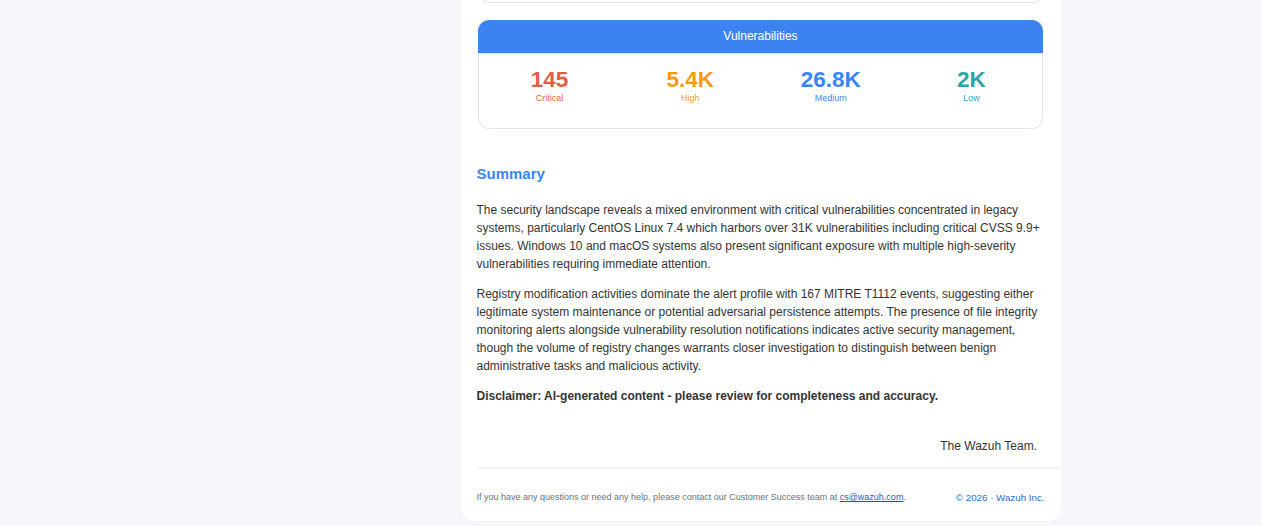
Wazuh AI analyst provides automated AI-powered security analysis for Wazuh Cloud environments. It analyzes security alerts, vulnerability data, and endpoint activity to generate insights that help organizations better understand their security posture and prioritize remediation efforts.
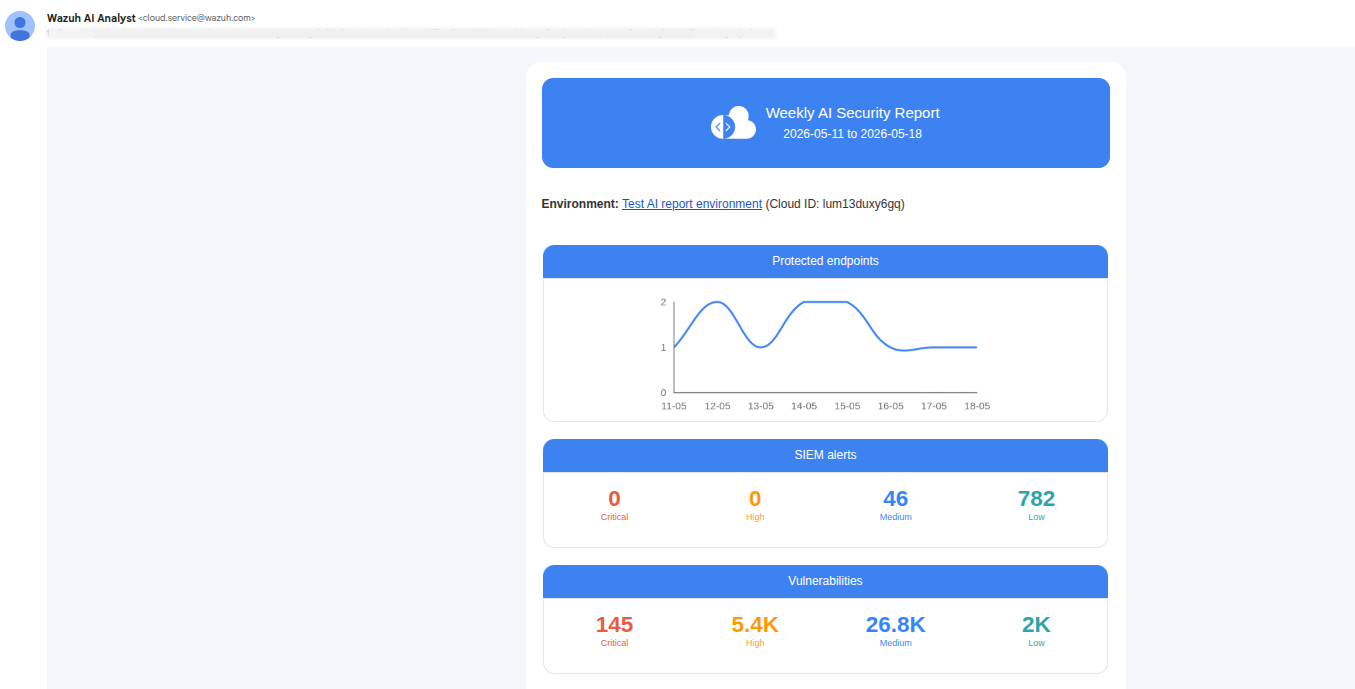
The service delivers weekly AI-generated assessments and recommendations through periodic reports, helping security teams identify trends, highlight high-risk activity, and streamline security investigations. By reducing the amount of manual analysis required, Wazuh AI analyst helps teams reduce alert fatigue, accelerate triage, improve operational efficiency, and focus more effectively on threat detection and response activities.
Compliance and security management
Wazuh Cloud is designed with security and regulatory compliance in mind, providing organizations with a fully managed and hardened platform. The service includes handling of protected data, regular application of security patches, and continuous hardening practices to help maintain a strong security posture.
The Wazuh Cloud also supports compliance requirements by adhering to standards such as PCI DSS and SOC 2. In addition, the platform undergoes independent audits to validate compliance and reinforce trust in its security controls.
Conclusion
As environments continue to grow in scale and complexity, organizations are increasingly required to balance visibility into infrastructure with control of operational overhead. Security platforms must be reliable, scalable, and continuously available, but they also need to integrate smoothly with teams already managing a wide range of security responsibilities.
In many cases, significant effort is invested in maintaining the platform itself, ensuring infrastructure scalability, handling upgrades, optimizing performance, and maintaining high system availability. This can reduce the time available for core security activities such as threat detection, investigation, and response, which are the primary drivers of security outcomes.
Wazuh Cloud addresses this challenge by providing a fully managed deployment of the Wazuh platform. It reduces the operational effort required to run and maintain security infrastructure, allowing teams to focus more on improving visibility, investigating threats, and strengthening their overall security posture. Organizations looking to simplify security operations while maintaining strong visibility and detection capabilities can explore the Wazuh Cloud trial.