
Open source software makes its source code publicly available, allowing anyone to inspect, audit, and improve it. This transparency creates verifiable trust, where security claims can be independently validated by a global community instead of taken on faith. Open source licenses give users full control to understand, customize, and extend the software to meet their needs. As a result, security and reliability are strengthened through collective oversight, not constrained by vendor-controlled black boxes.
Closed source software, in contrast, operates on a model of implicit trust by restricting access to its internal code. The lack of transparency forces organizations to rely entirely on the vendor’s proprietary security practices. Without the ability to independently verify the code, security flaws can remain hidden and create a significant trust gap that persists until a vulnerability is publicly discovered or actively exploited.
This article explores why open source software is increasingly seen as the future of cybersecurity, focusing on its ability to create systems that are both verifiable and secure. It also highlights how Wazuh embodies this model by delivering an enterprise‑level platform for threat detection, monitoring, and response.
Open source software in global digital infrastructure
Open source software is the core of modern technology, powering everything from mobile apps and programming languages to 90% of the world’s web servers. Its influence is universal, with adoption rates reaching up to 85% across industry software stacks. Linux serves as the bedrock for the Android operating system, all of the world’s top 100 supercomputers, and the mainframe environments driving global enterprise workloads.
This foundation extends across the infrastructure that keeps the digital world running. Widely used web development tools, including Appium, Dojo, jQuery, and Node.js, are open source. Modern container ecosystems such as Docker and Kubernetes are built on open source technologies, and the routers that move global internet traffic depend heavily on open source networking stacks. Major cloud providers, including Amazon Web Services, Google Cloud, and Microsoft Azure, rely extensively on open source to operate their platforms and to deliver services at scale.
How open source software is redefining cybersecurity
This section explains how open source is emerging as the future of cybersecurity. It shows how visibility, community-driven response, and regulatory alignment address the limitations of closed systems and strengthen security at scale.
Backdoors thrive in closed source software
Hidden source code allows malicious behavior to remain undetected for years, forcing organizations to blindly trust vendors, suppliers, and third‑party components without any way to verify their integrity. Blind trust is a security risk, and real‑world incidents have repeatedly shown how easily closed source software can be exploited. Without visibility, vulnerabilities, supply‑chain compromises, and even intentional backdoors can persist until they are actively exploited.
The Many‑Eyes principle
Transparency in open source software makes tampering harder, not easier. It gives security teams a deeper understanding of how their tools operate, strengthening practical engineering skills and improving overall defensive maturity. With constant public scrutiny, subtle malicious changes are far more likely to be caught, a concept known as the Many-Eyes Principle.
True interoperability
Open source enables true interoperability by letting organizations integrate and adapt their systems without being limited to a vendor’s ecosystem, proprietary formats, or paid add-ons. This gives organizations the freedom to build the workflows they need, adapt quickly to new threats, and avoid vendor lock‑in.
Faster, community‑driven response to threats
Security in open source is both a shared responsibility and a strategic advantage. With the code visible to everyone, fixes are not limited by a single vendor’s priorities but can come from a global community of developers, researchers, and administrators. This collective network functions like a distributed incident response team, identifying and resolving issues faster than a closed ecosystem can.
Government regulations regarding software supply chain risks
Governments are increasingly responding to high-impact supply chain attacks by pushing for stronger software transparency and accountability. As organizations rely more heavily on third-party and open source components, regulators expect organizations to know what components they deploy and to assess the risks they introduce. This shift reflects a broader awareness that a single compromised dependency can breach thousands of organizations.
Regulations and guidelines now require or strongly encourage the use of Software Bills of Materials (SBOMs). Regulations such as the United States Executive Order 14028 and the European Union Cyber Resilience Act, along with guidelines from bodies like NIST and CISA, require vendors to provide SBOMs as part of secure software development and procurement.
While these regulations require vendors to list software components, an SBOM alone cannot guarantee security if the underlying code remains proprietary. Open source software aligns closely with compliance expectations by providing both the software inventory and the source code. This allows for independent verification and continuous scrutiny across the software supply chain.
Security failures in closed source software
We examine four case studies that demonstrate how relying on closed source software can lead to serious and sometimes avoidable failures. These incidents highlight the risks that arise from limited visibility of software components and delayed discovery of vulnerabilities that exist within closed source software. In contrast, open source software models provide transparency and community scrutiny, helping organizations identify issues sooner and respond more effectively.
SolarWinds supply chain attack
The SolarWinds supply chain attack, which came to light in late 2020, targeted SolarWinds Orion, a widely used IT monitoring software across government and enterprise environments. Orion is closed source, and attackers, believed to be state-sponsored, compromised the SolarWinds build system and inserted a backdoor known as SUNBURST into legitimate software updates. These updates were digitally signed and pushed to customers, making the malicious code appear authentic.
The attack succeeded because it exploited implicit trust in the software supply chain. Customers had no visibility into the source code or build process, and the compromised updates were indistinguishable from legitimate ones. Over 18,000 organizations received the tainted software, with high-value targets, including U.S. federal agencies and Fortune 500 companies, being selectively exploited for espionage. Vendor-controlled supply chains can become single points of failure, and a lack of transparency and auditability in proprietary build systems significantly increases systemic risk.
Barracuda ESG appliance zero-day vulnerability
The Barracuda Email Security Gateway incident in 2023 involved a zero-day vulnerability in a closed source email security appliance widely used in enterprise environments. Threat actors exploited CVE-2023-2868 to gain persistent access to ESG devices, installing backdoors that remained active even after patches were applied. Due to the proprietary nature of the appliance, external scrutiny was limited, and detection was delayed.
The compromise exposed sensitive communications across government, defense, and critical infrastructure sectors, remaining undetected for months. Because the patch did not fully remediate the issue, Barracuda ultimately recommended replacing affected hardware. This incident highlights how proprietary security appliances can obscure persistent threats and limit a defender’s ability to independently verify remediation or detect deeply embedded compromises.
Microsoft Exchange zero-day exploits
Microsoft Exchange Server, a proprietary email software widely deployed in on-premises environments worldwide, was targeted in 2021 by a Chinese state-sponsored group known as Hafnium. They exploited multiple zero-day vulnerabilities, including CVE-2021-26855, CVE-2021-26857, CVE-2021-26858, and CVE-2021-27065, to gain remote access, escalate privileges, exfiltrate data, and deploy web shells for persistent access.
The attacks were effective because the closed source model of Microsoft Exchange Server limited independent code review and early discovery of implementation flaws. Slow patch adoption across many organizations further extended the window of opportunity for exploitation. An estimated 250,000 servers were affected, including roughly 30,000 organizations in the United States and thousands more globally.
Ivanti VPN exploits
Ivanti Connect Secure and Policy Secure VPNs, closed source remote access solutions widely used by enterprises and government organizations, were targeted in 2025. Multiple zero-day vulnerabilities, including CVE-2025-0282 and CVE-2025-0283, were exploited to bypass authentication and achieve remote command execution. Advanced Persistent Threat (APT) groups leveraged these flaws to deploy custom malware and maintain persistent access on compromised VPN gateways.
The attacks succeeded due to proprietary firmware and a lack of external auditability, which delayed detection. Attackers exploited the vulnerabilities before public disclosure, and the appliance-based deployment model made remediation more difficult. The impact included widespread compromise of remote access infrastructure across sensitive government and defense networks, with some organizations remaining unaware of the exploitation for weeks.
These case studies show the risks associated with software operating as a black box. While open source software has also faced serious issues, such as the XZ Utils backdoor targeting a widely used compression library, the difference lies in transparency and responsiveness. Transparent code and community review enable security professionals to discover vulnerabilities more quickly, validate findings, coordinate fixes, and verify that remediations are effective.
Wazuh as a blueprint for secure open source
Wazuh is an open source security platform that helps organizations gain visibility into their infrastructure and detect security risks across endpoints, servers, cloud workloads, and containers. It collects and analyzes system and security data to identify threats, vulnerabilities, misconfigurations, and unauthorized changes. These capabilities help organizations defend against evolving cyber threats.
Wazuh offers a practical example of how open source can meet the need for transparent and adaptable security solutions. It provides a free, community-driven approach to security that contrasts sharply with the opacity of many proprietary systems.
Fully open source
The Wazuh platform is free and open source, distributed under the GNU General Public License version 2 and the Apache License version 2.0. The entire codebase is publicly available on GitHub, where the public can use, review, modify, or redistribute the source code, follow development, report issues, or contribute enhancements.
Security audits
Wazuh bridges the gap between transparency and formal security assurance practices. While the Wazuh codebase is openly available for review, Wazuh also engages independent third-party security auditors to perform security assessments and penetration testing, similar to practices followed by commercial vendors.
Secure development practices
The Wazuh project combines static and dynamic analysis to detect bugs early in development and validate runtime behavior before features reach production environments.
Static code analysis
Wazuh uses static analysis tools, including Coverity, scan-build, and Cppcheck, to detect bugs, coding errors, and potential vulnerabilities before the software is compiled or executed. This early-stage analysis helps maintain code quality and reduces the risk of introducing security flaws.
Dynamic code analysis
To complement static checks, Wazuh uses dynamic code analysis tools, including AddressSanitizer, Dr. Memory, and Valgrind, to detect memory errors, runtime issues, and unsafe behaviors at runtime. These tools provide real-time insights into how the software behaves under different conditions, uncovering problems that static analysis might miss.
Community
Wazuh is supported by a vibrant, active network of security professionals, engineers, and system administrators who treat transparency as a core defense strategy. This community includes:
- Slack with over 19,000 members
- Reddit with over 10,000 participants
- Discord with 4,000 contributors
- Google Groups with 7,000 subscribers
Users actively deploy and customize the solution to fit their specific operational requirements while engaging directly with developers through collaborative channels. This interaction facilitates rapid feature development and tailored improvements that address real-world deployment challenges. In addition to functional enhancements, the open development process allows continuous, global peer review of the codebase by security researchers and users.
Cyber Threat Intelligence (CTI)
The Wazuh Cyber Threat Intelligence (CTI) service is a publicly accessible platform that provides actionable information on emerging cyber threats, with an initial focus on vulnerability intelligence. It focuses on providing timely updates on CVEs, severity ratings, exploitability, and recommended mitigation steps.
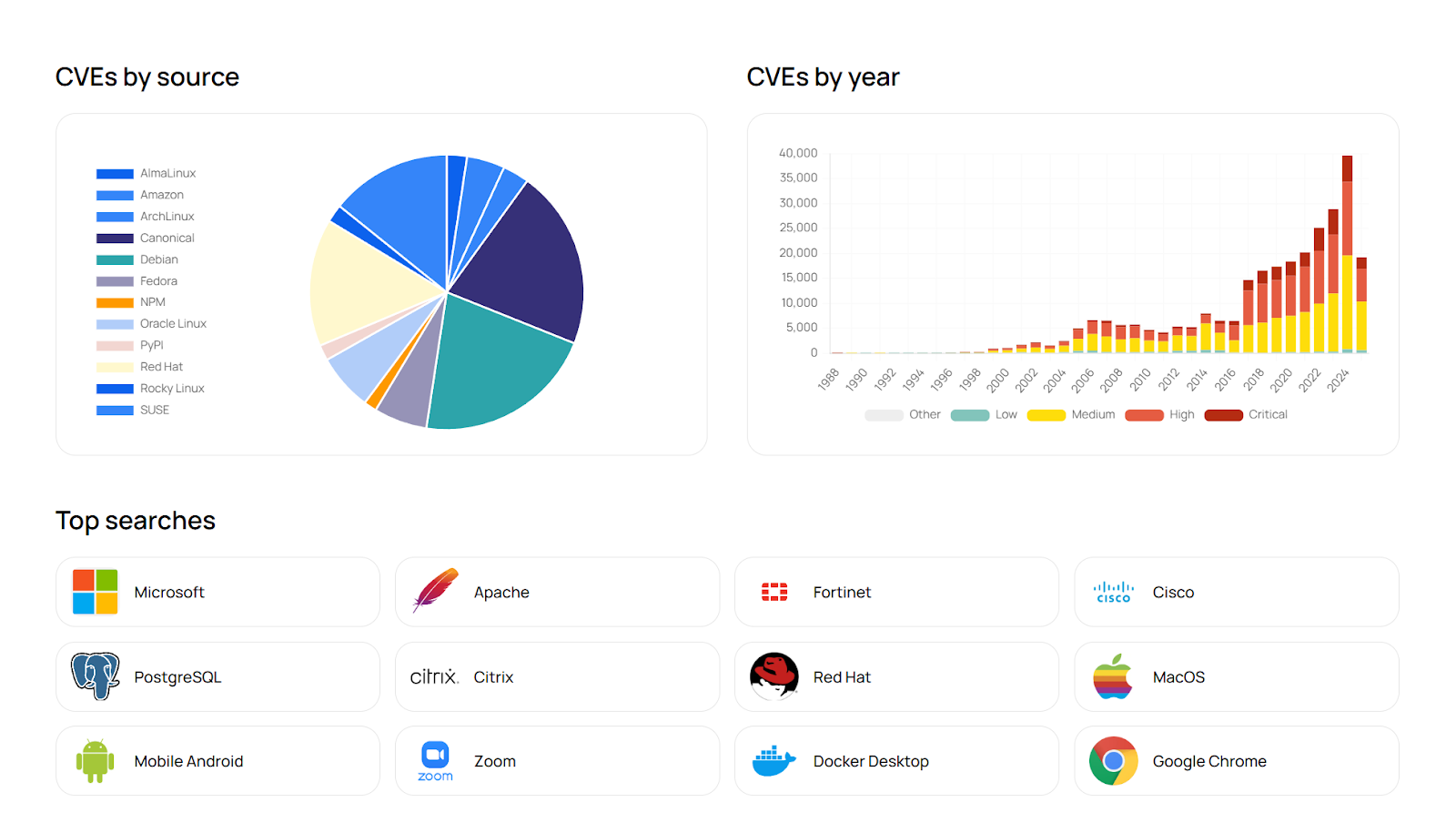
The service consolidates high-quality vulnerability data from trusted operating system vendors and reputable security databases, ensuring accurate and relevant intelligence. The Wazuh CTI service helps organizations reduce their attack surface and minimize the risk of exploitation or data breaches by delivering clear and current insights.
Conclusion
This blog post explores why open source software is central to the future of cybersecurity and how Wazuh applies the open source model to support modern cybersecurity operations. Closed source software limits visibility, making it harder for external researchers and defenders to identify vulnerabilities early. In contrast, the Wazuh open codebase, active global community, shared threat intelligence, and broad security capabilities improve visibility, accelerate bug discovery, and enhance security operations. By combining openness with enterprise-level security capabilities, Wazuh offers a blueprint for a more resilient and trustworthy approach to cybersecurity.
References
- SolarWinds hack explained: Everything you need to know
- Barracuda Email Security Gateway Appliance (ESG) Vulnerability
- HAFNIUM targeting Exchange Servers with 0-day exploits | Microsoft Security Blog
- Security Advisory Ivanti Connect Secure, Policy Secure & ZTA Gateways (CVE-2025-0282, CVE-2025-0283)
- Why Do Enterprises Use and Contribute to Open Source Software – Linux Foundation
- CISA Open Source Software Security Roadmap
- Executive Order 14028, Improving the Nation’s Cybersecurity | NIST
- Executive Order on Improving the Nation’s Cybersecurity | CISA
- Cyber Resilience Act | Shaping Europe’s digital future
- McGowan, Tristan. Engineering Trust: Free Software as the Future of Cybersecurity. Free Software Foundation. Slide deck.